
Stanislaus County Busted Mugshot Records
A Stanislaus County booking begins after an arresting agency delivers a person for intake into the Sheriff’s unified detention system. Staff confirm identity, assign a seven-digit booking number, log the arrest time and agency, record the booked allegation, and note the detention placement. An intake identification photograph may also be created. The public booking entry and the photo are related records, yet they are not the same thing. The Sheriff roster reviewed is rich in text fields but has no visible photo field.
That distinction prevents a common error. A person can have a Stanislaus County arrest record even when no mugshot appears online. The record also does not prove the booked charge was filed or sustained. Prosecutors can change or decline charges, and a court can dismiss counts, accept a plea, acquit, or convict. Anyone named in a booking record remains presumed innocent unless guilt is proved in court.
Stanislaus County Booking Record Fields
The modern Sheriff interface shows enough identifiers to separate people with similar names and to follow a case beyond the jail. Initial cards present identity and booking basics. The full-detail view adds custody, charge, bail, and court data. Some fields may be blank because a value has not been entered, a status changed, or disclosure is restricted. A charge is the allegation booked by law enforcement, while a disposition is the court’s later outcome.
| Field | What it shows |
|---|---|
| Name, date and place of birth | Identity details used to reduce false matches. |
| Booking number and date | The seven-digit event identifier and date of intake. |
| Arrest time and agency | When the arrest was logged and which agency made it. |
| Facility and release date | The listed detention site and a release value when populated. |
| Booked charge and bail | The intake charge and bail information at that point in the case. |
| Case number and court date | Keys for moving from the jail entry to court records. |
The roster won't show everything. No mugshot, home address, or probable-cause account appears there. Full physical descriptions and final court dispositions are missing too. California Government Code § 7923.610 does name other public arrest facts, subject to safety and investigative limits. Even so, the statute doesn't force each fact onto a web roster. When an item you need is absent, a focused records request is the better route.
Note: Match at least two identifiers, preferably a booking or case number plus date of birth, before treating two records as the same person.
Request Stanislaus County Busted Records
Sheriff Records is the official fallback when a booking record or intake image isn't visible online. Keep the request narrow. A targeted ask is far easier to identify and review than a demand for a whole investigative file. The Sheriff's form asks for the report number, requester details, suspect name, incident time and place, your relationship to the case, any juvenile involvement, and the purpose. A detective or supervisor may review it first. Fees run $5 for the first four pages, then $1 per page after that. No booking-photo fee has been verified.
- Collect the full name, date of birth if known, seven-digit booking number, and booking date from the official roster.
- Ask separately for the booking record and booking or intake identification photograph in the existing electronic format.
- Request all reasonably separable public parts and a written citation for any exemption used to withhold material.
- Ask for a cost estimate before duplication and confirm the current counter hours before visiting.
250 E. Hackett Road
Modesto, CA 95358
Records: (209) 525-7117
Fax: (209) 525-7111
Reported hours: weekdays, 8 a.m. to 5 p.m., holidays excluded
Timing works differently than most people assume. Under the California Public Records Act, an agency usually gets ten days to decide whether a request seeks disclosable records. That's a decision deadline, not a delivery one. Unusual circumstances can stretch the determination by up to fourteen more days with written notice. Search, review, redaction, and copying can add still more time. California Attorney General Opinion 03-205 treats booking photos as public records. Still, a sheriff keeps discretion within that framework. Release is never guaranteed.
Stanislaus County Mugshot Request Fees
Fees depend on which office holds the material. Never transfer one agency's charges to another. The Sheriff's report-copy price says nothing about the cost of a jail intake image. By the same token, a city's fee for a police photograph doesn't mean the city holds the Sheriff's booking photo. Ceres published no fee in the Records material available.
- Sheriff Records: $5 for the first four report pages, then $1 per page; no photo-specific fee verified.
- Modesto Police: $0.10 per page plus tax and a $10 photograph service charge on its form.
- Turlock Police: the first 15 report pages are free, then the fee is $0.15 per page.
- Ceres Police: no located published copy price or separate photo price.
Ask about the fee before any work begins. A Modesto Police photo might be attached to a city report, a crime scene, or an evidence file rather than the county intake process. For a jail booking image, start with Sheriff Records. For a city police report, use that city department's process. Each request then lands with the office most likely to actually hold the record.
Note: A published report-copy price is not a promise that a photograph is available, public, or priced under the same schedule.
California Busted Mugshot Removal Laws
California law draws several separate lines here. Civil Code § 1798.91.1 bars a publisher from taking payment or anything of value from the photographed person to remove, correct, alter, or withhold a booking image. The rule won't erase an image on its own. It does let a public entity charge a reasonable administrative fee to correct a photograph. Avoid any private service promising a guaranteed purge. For the full picture on which arrest facts stay open, the official public arrest-record statute sets out the rules, subject to its stated safety and investigative limits.
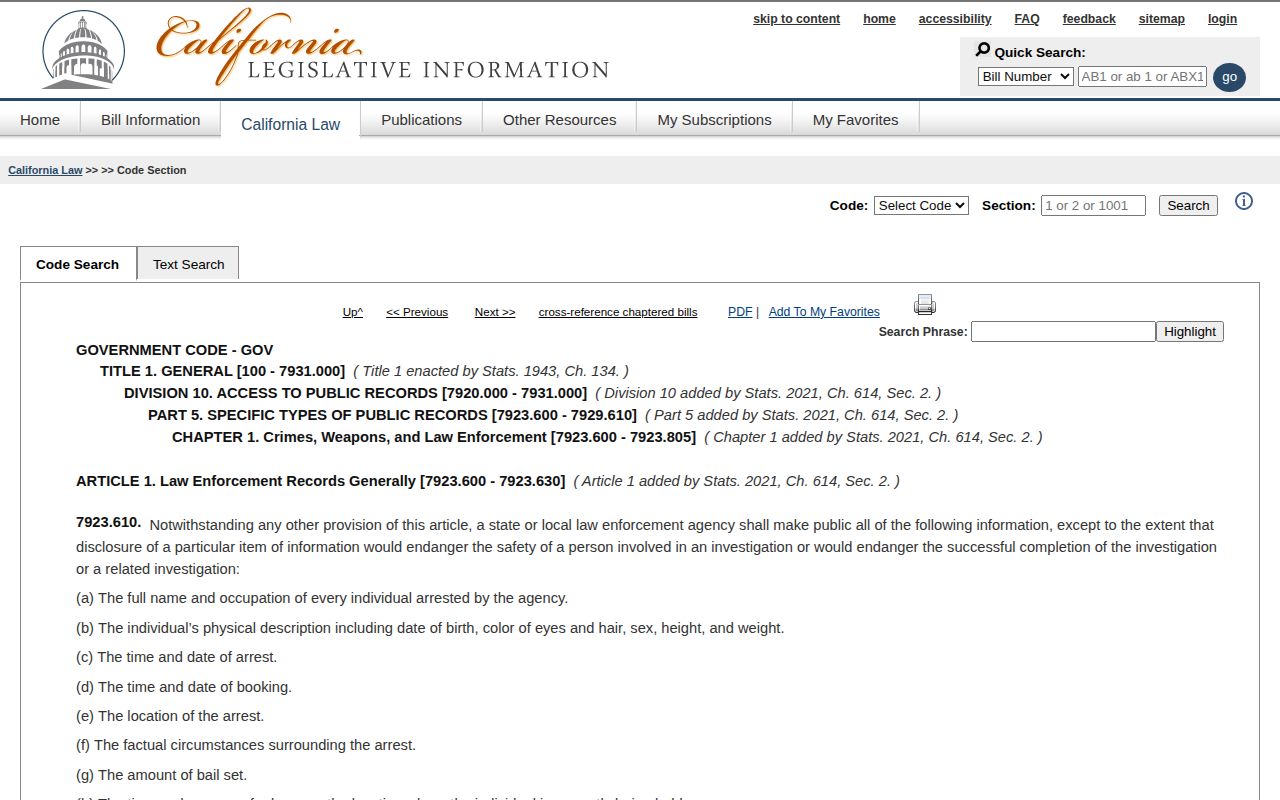
Keep expectations in check. The statute lists public arrest facts but never promises that each one will surface in the Sheriff's web roster, nor that a booking image will be released in every case.
Social media follows a different rulebook. Penal Code § 13665 generally bars an agency from posting a booking photo after many nonviolent arrests unless a statutory exception applies, and it usually requires removal of a social post within fourteen days once an exception ends. Exceptions cover fugitive or imminent-threat concerns, a judge's order for a legitimate law-enforcement purpose, and exigent need. The statute's definition excludes agency-operated websites and databases. So the fourteen-day social-media rule is no promise that a roster entry or agency record will ever vanish.
Note: California’s fourteen-day social-post rule does not set the retention period for the Sheriff’s roster, database, or underlying booking file.
Correcting Stanislaus County Busted Results
A qualifying arrest without a conviction may be eligible for sealing under Penal Code § 851.91. California Courts identifies paths that may apply when charges were never filed, were dismissed and cannot be refiled, diversion ended in dismissal, an acquittal occurred, or a conviction was vacated or reversed with no possible refiling. Eligibility depends on the facts and procedure. Some records may receive automatic Department of Justice relief under § 851.93.
A Penal Code § 1203.4 dismissal, often called expungement, is different. It can set aside an eligible plea or verdict and dismiss the accusation, but it does not necessarily seal the public file or erase every consequence. The Stanislaus court packet uses CR-180 and CR-181 and describes separate petitions for separate convictions. Current California Courts guidance should control eligibility questions because local packet material can predate later statewide changes.
After obtaining an order, send it first to the arresting or record-holding agency. Then use each publisher’s free correction route. RecentlyBooked’s free policy asks for the exact URL, name, arrest date, county and state, reason, and documents by email. Mugshots.com record maintenance describes free updates or removal for stated orders and outcomes, with a listed review period of up to ten business days. Busted Newspaper has a general free form, although no verified California or Stanislaus section was found. No accessible free policy was verified for Arrests.org or Mugshots.zone. Once the source changes, a search engine’s outdated-content tool may refresh a stale result, but it cannot delete a live unchanged source.
Hidden Stanislaus County Arrest Records
A blank search result does not mean nothing happened. Welfare and Institutions Code § 827 restricts juvenile case files to listed individuals or those with a court order. Section 781 and related provisions govern juvenile sealing. Other gaps are possible too. Protected victims, sealed adult matters, information that could compromise an investigation, or facts whose release creates a safety risk may be missing or redacted.
Ordinary delays cause blanks as well. Processing lag, a misspelled name, a citation issued without jail admission, a fast release, a transfer, or a data correction can all empty a result. Try again with the right date and more than one identifier. When the matter is juvenile or sealed, use the proper court or agency process rather than working around a lawful access limit.
Note: A photo-free or missing public result can reflect legal protection, timing, release, or data scope rather than the absence of an event.
Find Stanislaus County Busted Mugshots
Match the search to the custody stage first. Stanislaus County has no single all-purpose arrest feed. Someone booked into local detention shows up in the Sheriff search. A city incident may surface in a Turlock or Ceres report even without jail admission. Released people drop out of the current-custody snapshot while booking detail lives elsewhere. State, federal, and civil immigration systems each track their own groups.
- Search the Sheriff Who’s in Jail portal by exact name, date of birth, or booking number.
- For present local custody, compare the result with the legacy current-custody report and its run time.
- Check the relevant city activity source, then retry the county roster if intake may still be in progress.
- Request the intake photo from Sheriff Records because no image field was visible on the roster reviewed.
- Carry the case number into the Superior Court search and calendar to learn what happened after booking.
- Use CDCR, BOP, or ICE only when the person’s later custody stage calls for that distinct system.
Can a face alone confirm identity? No. People change their look, image quality varies, and strangers can look strikingly alike. Recycled third-party thumbnails add more confusion. Confirm the booking ID, date, agency, and court case before attributing a record to anyone.
Two Stanislaus County Booking Views
The county runs two official booking views, and they serve different purposes. The modern interface takes a name, a date of birth, or a seven-digit booking number, with controls for all-inmate and booking-date browsing. A full record can show the facility, release date, booked charge, court case number, bail, and court date. It states no update rate or online retention period, and no photograph field appears.
The legacy Who's in Custody report is a snapshot of who is held right now. It refreshes roughly every ten minutes and spans Detention Center East and West, REACT, and the minimum-security units. That cadence applies only to the legacy report. It doesn't promise a new arrest online within ten minutes, nor does it say how often fields in the modern portal change.
| Search field | Type | Required | Notes |
|---|---|---|---|
| Name | Text | No single field is stated as required | Use exact spelling and confirm with another identifier. |
| Date of birth | Date | Optional search route | Useful for separating people with the same name. |
| Booking number | Seven-digit number | Optional search route | Strongest key for one county booking event. |
| Booking date controls | Date filter | Optional | Supports date browsing but is not a promised feed window. |
Start with the modern portal. Pull up the full booking detail and jot down the facility, release field, charge, bail, case number, and court date. Then go to the legacy report for one purpose only: checking whether the person is locally held right now. If the two records disagree, or a release field reads unclearly, call Sheriff Records instead of guessing.
A changed facility label does not mean a new arrest. The unified system includes a 552-bed detention center, a 288-bed REACT programming and reentry facility, and minimum-security units. Movement between them can reflect placement or program needs alone. That proves neither release nor a fresh booking.
Stanislaus County Busted Photo Limits
The official booking roster and California's social-media rule govern two different kinds of publication. The Sheriff interface carries detailed identity, arrest, custody, charge, bail, case, and court fields but no visible booking-photo control. That describes the public portal only. Sheriff Records handles focused photo requests.
Penal Code § 13665 sets a general fourteen-day removal rule for covered law-enforcement social-media posts, with stated exceptions. It does not reach agency websites or electronic databases. So a social image can vanish while the booking record stays public. A text roster can also run indefinitely without a photo. Judge each channel by its own policy and law.
Stanislaus County Busted Booking Feeds
Stanislaus County has no dedicated public feed for the last 24 hours, 48 hours, 72 hours, or the week. Instead, use the booking-date filter built into the Sheriff roster, then cross-check the current-custody report. Treat those tools as a workaround, not a guaranteed busted feed. The Sheriff also says nothing about how far the modern interface reaches back, so older bookings may simply vanish from view.
The cities help somewhat. Turlock posts a Daily 24 Hour Patrol Supervisor Report you can select by date. Ceres publishes weekly adult arrest-log PDFs and asks that older logs be requested in person through Police Records. Modesto offers no daily or weekly arrest log at all, so its path runs through Police Records and the Sheriff roster. One caution: a patrol report or police log shows police activity, not jail custody. Someone cited and released the same night may appear there without ever entering a county cell.
No special weekend window exists either. Search by booking date, pick the right city product, and expect processing delays. For a span of several days, select multiple Turlock dates or the matching Ceres weekly PDF. Older material means requesting the official record. And if an entry is missing online, the cause could be release, transfer, a spelling mismatch, protected status, or plain lag.
Note: Stanislaus County has no verified official 72-hour booking feed; manual date searches and records requests are the documented alternatives.
Where Stanislaus County Mugshots Appear
Official sources come first. The Sheriff roster gives you the booking text, the custody report confirms a local hold as of its run time, and Records handles a targeted photo request. Court records settle what happened to the case later. Secondary publishers and newspapers can supply leads, though their material may run late, stay incomplete, or simply be wrong, and it can linger after the official status changes.
| Channel | Photo status | Use |
|---|---|---|
| Sheriff roster | No visible photo field reviewed | Official booking identifiers and case bridge. |
| Sheriff Records | Request subject to review | Official booking record and intake-photo fallback. |
| Superior Court | Not a photo locator | Filed charge, hearing, and public disposition research. |
| CDCR | Separate reviewed request path | State-prison record and identification-photo request. |
| Local news | Varies by story | Event context, never a custody census or docket. |
| RecentlyBooked | Unofficial, provenance concern | Claimed 30-day lead that requires official verification. |
| Mugshots.com | Inconsistent and apparently historical | Possible old spelling or date lead, not current status. |
The RecentlyBooked Stanislaus page does exist as a verified county section. Just remember that its claims belong to the publisher, not the Sheriff.
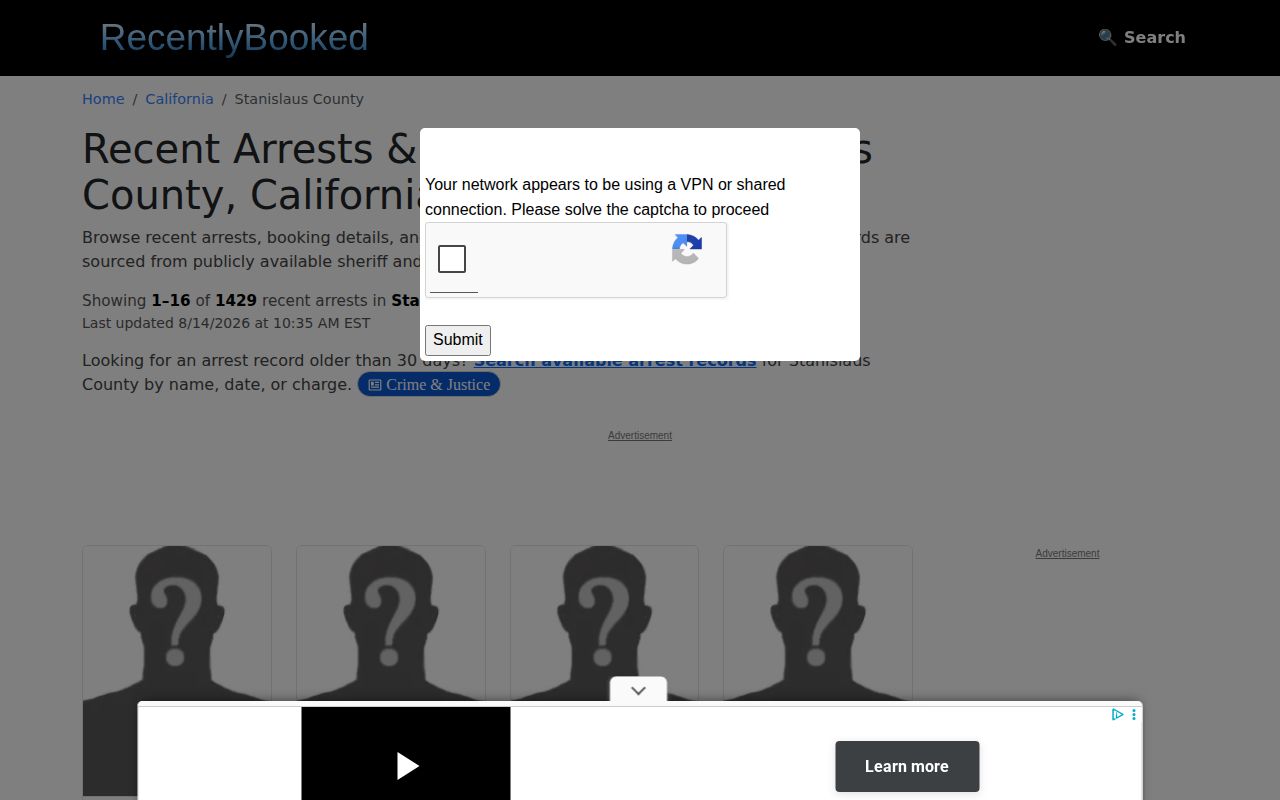
One provenance problem: that publisher says its source supplies no mugshot images, so any photo slot deserves skepticism. Check its entries against Sheriff and court records before trusting them. Mugshots.com has a real county page, but its visible year filter stops at 2016, and a sampled entry dated to 2013. Busted Newspaper showed no verified California listing, and neither Arrests.org nor Mugshots.zone had a usable local section. Never guess at a local URL.
Local journalism fills in around the edges. The Modesto Bee Crime section offers the widest coverage, following arrests, filings, trials, and sentencings countywide. Turlock Journal runs recurring multi-day police blotters, while Ceres Courier covers city crime and sometimes prints agency-supplied arrest photographs. Photo use varies by story. These outlets are newsrooms, not booking feeds, custody lists, or court dockets.
Stanislaus County Busted Court Follow-Up
A Sheriff booking detail often includes the case number and court date, and that pairing opens the cleanest route to the courtroom outcome. Begin at the official Superior Court case-search landing. From there you reach the public portal, which can identify a case and display some filed documents. Plenty of things can shrink what appears: remote access limits, sealed records, document type, privacy controls, plain technical trouble. A portal error never proves the case is absent.
When a linked session goes down, the official court-search landing still shows the durable route back in.
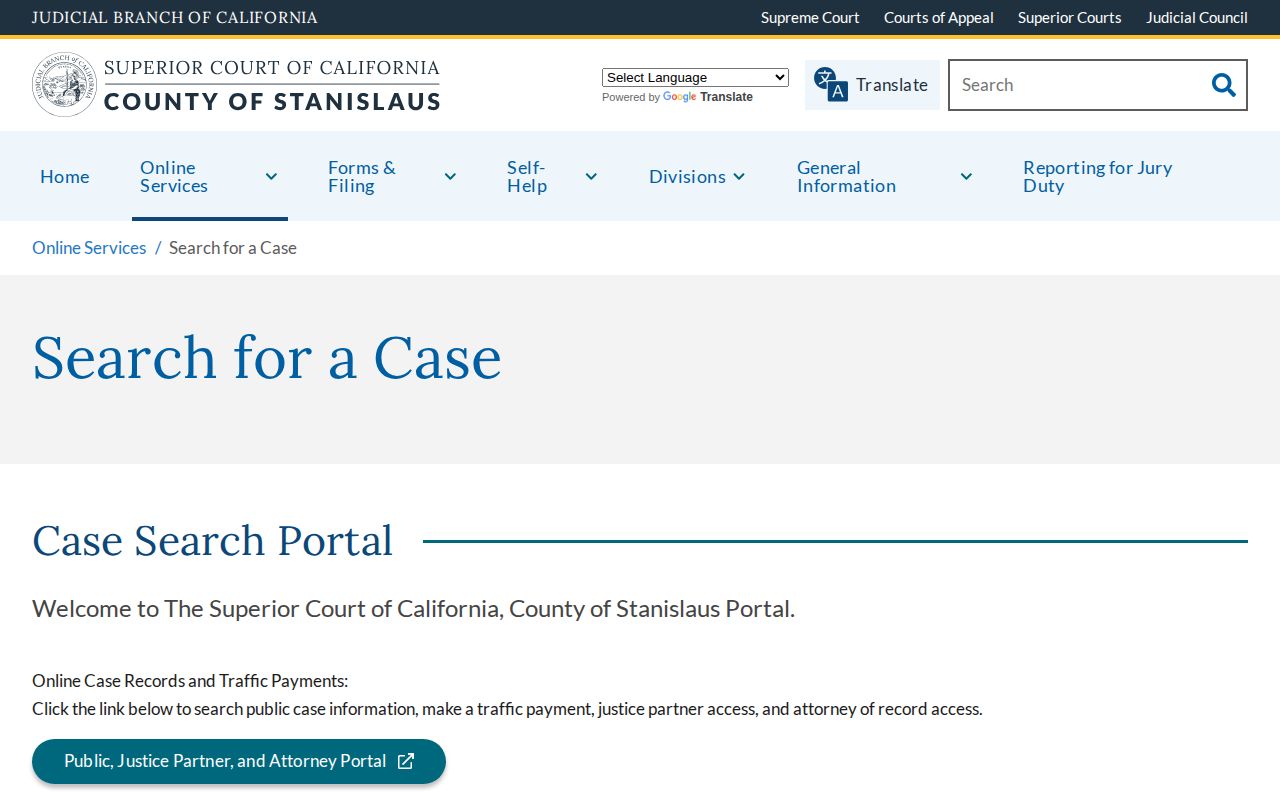
Use the court clerk, courthouse access, or a records request when remote results are incomplete. The criminal calendar is best for hearing navigation, not for the final outcome. It can show the date and time, case number, party and role, judicial officer, and hearing type. A hearing can be continued or changed.
Arraignment is the hearing where the accused hears filed charges and enters a plea. Bail is a release amount or status, not proof of payment or release. Disposition is the case outcome, such as dismissal, plea, acquittal, or conviction. The booked allegation and the court charge can differ. For an old file, preserve the case number: court research without it can carry a $15 fee, plus listed copy, certification, or offsite retrieval charges, and old-file work can take six to eight weeks.
Stanislaus County Arrest Search Failures
The Superior Court's branded case-search landing stays the authoritative entry point even when its portal rejects a session. That rejection usually traces to automation blocks or privacy filters, not to a missing case. Remote criminal access can also hide sealed or confidential records and anything restricted by California access rules. A failed session, a sparse result, or a missing document tells you nothing reliable about whether a case was filed.
When the portal falls short, use the Criminal Division's clerk research route, a courthouse terminal, or the certified-copy process. Bring the full name and any aliases, date of birth, filing year, offense type, and the Sheriff case number if you have it. The criminal calendar can point you toward an upcoming hearing. For the final disposition, though, the docket or a certified order carries far more weight.
Note: A portal error is a reason to use clerk research, not evidence that the arrest or court case never existed.
Stanislaus County Arrest Custody Paths
Custody status picks the locator. Freshly booked or currently held in Stanislaus County? That search belongs with the Sheriff. Someone released from local custody may drop off the snapshot, yet the booking record can still sit with the Sheriff while the case moves through court. A person sentenced to state prison moves into CDCR's system instead. Federal and immigration custody run through entirely different authorities and databases.
- Booking
- Administrative intake after arrest, including identity, charges, and a booking number.
- Arraignment
- The first court stage at which filed charges are stated and a plea is entered.
- Bail
- A court-set release amount or status that can change as the case proceeds.
- Disposition
- The later court result, which may differ from the charge at booking.
- Expungement
- A common name for certain dismissals under Penal Code § 1203.4, not automatic erasure.
State-prison commitments show up in CDCR CIRIS, which lists a name, age, CDCR number, location, admission date, county of commitment, and parole-eligibility timing. One thing it lacks is a photo. CDCR keeps a separate media-policy route for requesting an identification image, though safety and investigative exceptions can block it. Federal inmates from 1982 forward appear in the BOP locator. That tool has no photo either. ICE runs its own locator for current or recently released civil immigration detainees, and it too comes back picture-free.
Stanislaus County Detainers and Bookings
Keep an ICE detainer separate from anything local. It is not a county conviction, a booked charge, or a judicial warrant. The Sheriff's immigration policy draws a clear line between federal civil holds and criminal custody authority under California limits. So treat the two systems as two systems: a county roster shows local booking and custody, while the ICE locator tracks a civil detention process that runs on its own.
Federal pretrial custody deserves the same care. The BOP locator can miss someone held before BOP placement, and the Marshals Service offers no broad public locator at all. Marshals policy generally withholds booking photographs after arrest, since routine release serves no law-enforcement purpose, though wanted or fugitive images get different treatment. Whatever system you search, confirm identity and authority first.
Note: County booking, state prison, federal pretrial detention, and civil immigration custody are distinct legal and record systems.
Stanislaus County Arrest Status Alerts
Three local alert tools answer three different questions. California VINE tracks custody status and sends phone or email notice when that status changes; the Sheriff's VINE page lists (877) 411-5588. CrimeMapping adds incident and location context for unincorporated areas and Sheriff-contract cities, but a mapped event is not the same as an arrest. StanAware covers major emergencies and disasters, not bookings or releases.
The official Sheriff app for iOS and Android handles tips, reports, public-safety news, and interactive features. Its store descriptions promise no inmate search, booking feed, or booking photographs. So skip it as a hidden mugshot source. It is also no substitute for an emergency line.
Which alert tracks release? VINE, full stop. It delivers custody-change notices, though it offers no booking photo. In an emergency, call 911; for nonurgent public-safety matters, use the proper agency channel.
Older Stanislaus County Busted Records
No official source spells out a booking-photo retention term for Stanislaus County. Nor does it name an automatic archive destination. The modern roster's all-bookings controls and release field stay silent on how long an entry remains online. A tidy five-year claim would be guesswork. Older county agenda references cover other retention schedules, so they cannot back a five-year mugshot rule either.
Ask Sheriff Records for the schedule entries now in force. Cover booking or intake photographs, booking jackets, jail-management booking records, and arrest logs. Request the series title, the retention period, and the disposition instructions. The answer tells you whether an older item still sits with the Sheriff, moved to county storage, or was lawfully destroyed.
The California State Archives holds historic Folsom and San Quentin identification cards and albums. A county-of-commitment field can point you to someone sent from Stanislaus County. Keep in mind these are state-prison identification images, not transferred county-jail mugshots. Search the Minerva catalog first. Then give Archives staff a name or aliases, approximate birth and commitment dates, likely prison, prison number if known, offense, and county of commitment.
Busted Mugshots Across Stanislaus County
Modesto, Turlock, and Ceres all funnel bookings to the same county destination once someone enters detention. Yet each city publishes differently. Modesto has no verified dedicated arrest log. Official records and the county roster lead the way there. Turlock posts a selectable 24-hour patrol report. Ceres puts out weekly adult arrest PDFs and sends older-log requests to Police Records. None of these city products amounts to a live jail census or a guaranteed photo source.
- Modesto Busted Mugshots: Modesto Police arrests that enter county detention flow to the Sheriff booking system; city Records is the police-report fallback.
- Turlock Busted Mugshots: the police patrol report provides a selected day of activity, followed by Sheriff custody verification.
- Ceres Busted Mugshots: week-range adult arrest logs offer city action and case details, followed by the Sheriff facility and release fields.
Those differences matter when you're digging into who got busted. Police contact can end in a citation or release with no jail admission. A jail record can also surface after the city report appears. Use each city source for its stated window first. Then turn to county booking and court records for custody and the full picture.
Get Stanislaus County Booking Records In Person
Stanislaus County Sheriff's Office, Records Division
250 E. Hackett RoadModesto, CA 95358
(209) 525-7117